


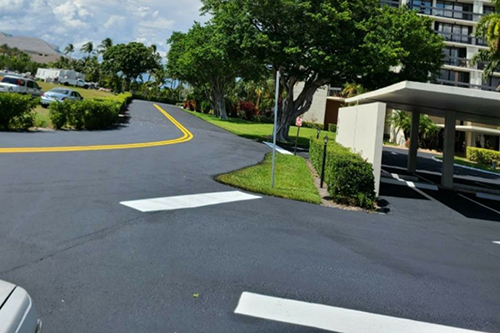
A cracked parking lot, faded crosswalk, standing water, or deteriorated accessible parking area can become more than a maintenance concern for a community association. In Palm Beach County, heavy rain, intense sun, frequent vehicle traffic, and year-round property use can turn relatively small pavement defects into safety issues if they are allowed to worsen.
Proactive asphalt maintenance can help HOAs and property managers reduce preventable hazards by identifying pavement deterioration early, correcting walking and driving surfaces, maintaining visible traffic markings, and keeping parking areas in serviceable condition. Maintenance cannot eliminate every accident or liability exposure, but a documented inspection and repair program can demonstrate that pavement safety is being actively managed rather than ignored.
What local HOA boards and property managers should know
-
Small cracks, potholes, uneven transitions, loose pavement, and standing water should be documented and evaluated before deterioration spreads.
-
South Florida heat, ultraviolet exposure, rainfall, and drainage demands can accelerate pavement wear across Palm Beach County communities.
-
Faded crosswalks, directional arrows, fire-lane markings, stop bars, and parking-space lines can create confusion even when the pavement itself remains structurally usable.
-
Accessible parking spaces, access aisles, and routes should be included in pavement inspections rather than treated as ordinary striping areas.
-
Maintaining inspection records, photographs, repair dates, and contractor documentation can help management teams establish a consistent maintenance history.
Why Does Proactive Asphalt Maintenance Matter for Palm Beach County HOAs?
Proactive asphalt maintenance matters because HOAs and property managers oversee common areas that residents, guests, vendors, employees, and service vehicles use every day. Identifying pavement hazards before an incident occurs can improve safety, control deterioration, simplify budgeting, and reduce the likelihood that a known defect remains unaddressed.
In West Palm Beach and surrounding communities, pavement rarely gets a long seasonal break. Parking lots, private streets, clubhouse entrances, mail areas, pool parking, and community drives may remain active throughout the year.
South Florida conditions add another challenge. Strong sunlight can contribute to asphalt oxidation and surface deterioration, while recurring rainfall tests drainage systems and existing cracks. Water that reaches weakened pavement or its supporting base can make an existing problem more difficult to correct.
Communities in Wellington, Royal Palm Beach, Lake Worth Beach, and Palm Beach Gardens can face different traffic patterns and property layouts, but the risk-management principle remains the same: inspect routinely, document conditions, prioritize hazards, and schedule maintenance before defects become more severe.
All American Asphalt LLC serves the West Palm Beach, FL area. We help property decision-makers evaluate asphalt conditions and identify maintenance and safety improvements appropriate for their paved areas.
What Do Florida Requirements Mean for Association Pavement Maintenance?
Florida requirements make it important for associations to understand who is responsible for maintaining each common area and to address safety and accessibility obligations that apply to the property. Governing documents, property type, state law, local requirements, and federal accessibility standards can all affect a specific association’s responsibilities.
Florida Statutes Chapter 718 states that condominium associations are responsible for maintenance of common elements except where responsibility for particular limited common elements is assigned differently by the declaration. Florida’s HOA statutes also recognize association governance and common-area responsibilities, although the governing documents of an individual HOA remain important.
Accessibility is another consideration. The U.S. Department of Justice’s ADA standards address accessible parking spaces, access aisles, accessible routes, surface conditions, slopes, markings, and other design requirements where those standards apply.
An asphalt contractor can identify visible paving and marking concerns, but association boards and property managers should consult qualified legal, accessibility, engineering, or other professionals when determining whether a specific site meets applicable requirements. Pavement maintenance is one part of a broader risk-management program, not a substitute for legal advice.
How Can Asphalt Conditions Affect Safety Around a Community?
Asphalt conditions affect safety by influencing how predictably pedestrians, cyclists, drivers, mobility-device users, delivery personnel, and maintenance crews can move through a property. Uneven pavement, broken edges, deteriorated crossings, standing water, and unclear traffic markings can create avoidable conflict points in otherwise familiar community areas.
This is especially important at high-activity locations such as clubhouse parking lots, pool entrances, mail kiosks, gatehouses, dumpster areas, visitor parking, and pedestrian crossings.
A resident may know a community road well, but a delivery driver or first-time guest may not. Clear striping, visible directional markings, smooth transitions, and properly maintained walking routes help make pavement behavior easier to understand.
For West Palm Beach property managers overseeing multiple sites, standardized pavement inspections can also make it easier to compare conditions and prioritize limited maintenance budgets.
What Asphalt Warning Signs Should Property Managers Document?
The most important asphalt warning signs are defects that can affect footing, drainage, vehicle movement, accessibility, or the continued integrity of the pavement. Management teams should document their location, approximate extent, photographs, and whether the condition appears to be changing.
Watch for:
-
Potholes or depressions in vehicle and pedestrian areas.
-
Cracks that are widening, multiplying, or allowing vegetation to grow.
-
Uneven transitions between asphalt, concrete sidewalks, curb ramps, drains, or utility structures.
-
Standing water that remains after surrounding pavement has drained.
-
Crumbling pavement edges or loose aggregate.
-
Faded crosswalks, parking lines, stop bars, arrows, or curb markings.
-
Deterioration within accessible spaces or access aisles.
-
Repeated damage in areas used by garbage trucks, delivery vehicles, buses, or other heavy traffic.
A visible defect does not automatically establish liability. It does, however, give a management team a condition that can be evaluated, prioritized, and documented instead of discovered for the first time after a complaint or incident.
When Should an HOA Call an Asphalt Professional?
An HOA should call an asphalt professional when pavement defects are recurring, spreading, affecting drainage, creating uneven surfaces, or extending beyond minor cosmetic deterioration. Professional evaluation is also appropriate when a board needs to plan repairs across a larger property rather than repeatedly addressing isolated trouble spots.
Routine visual checks can be performed by managers or maintenance personnel. Photographs taken from consistent locations can help track changes between inspections.
Professional input becomes more valuable when there are potholes, widespread cracking, base-related movement, significant ponding, failed patches, deteriorated high-traffic areas, or questions about whether repair, resurfacing, or replacement is the more practical approach.
In communities near Delray Beach, Boynton Beach, and central Palm Beach County, planning work before extensive deterioration develops may also make it easier to coordinate resident notices, parking closures, traffic control, and contractor access.
What Common Local Conditions Contribute to Pavement Deterioration?
Palm Beach County pavement commonly faces a combination of sun exposure, water intrusion, drainage problems, traffic loading, and aging materials. These conditions often interact, which is why simply filling the most visible pothole may not address the reason the pavement keeps failing.
1. Sun and heat exposure: Strong South Florida sunlight contributes to asphalt aging and oxidation over time.
2. Rain and water intrusion: Cracks can provide pathways for water to reach lower pavement layers.
3. Drainage problems: Depressions, clogged drainage areas, or improper surface flow can leave water standing on pavement.
4. Heavy vehicle traffic: Waste collection trucks, moving vehicles, delivery trucks, landscaping equipment, and maintenance vehicles place concentrated loads on community pavement.
5. Deferred maintenance: Small defects generally give water and traffic more opportunity to worsen surrounding pavement when they remain open.
Properties throughout West Palm Beach benefit from looking at these conditions together rather than treating each crack as an unrelated event.
How Can HOAs Prevent Pavement Hazards From Becoming Larger Problems?
HOAs can prevent many pavement problems from escalating by combining scheduled inspections with timely crack repair, pavement repairs, drainage review, surface maintenance, and refreshed safety markings. The goal is to intervene at the appropriate stage rather than waiting until every deteriorated area requires major reconstruction.
A practical maintenance routine can include seasonal pavement walks, photographs of recurring problem areas, resident or staff reporting procedures, and periodic professional evaluations.
Before and during South Florida’s wetter months, pay particular attention to ponding areas, drainage paths, pavement depressions, and cracks where water is entering.
Striping should also be reviewed after pavement work. Fresh asphalt without clear parking stalls, crosswalks, accessible markings, traffic arrows, or stop bars can leave the property with an incomplete safety upgrade.
DIY observation is useful. Structural diagnosis, major patching, resurfacing, accessibility layout, and significant drainage corrections should be left to appropriately qualified professionals.
What Results Can an HOA Expect From Proactive Asphalt Maintenance?
Proactive asphalt maintenance can provide smoother pavement, clearer traffic organization, better-defined parking areas, earlier control of deterioration, and a more predictable maintenance plan. The exact result depends on pavement age, underlying conditions, drainage, traffic loads, previous repairs, and the maintenance method selected.
Crack treatment may help limit water intrusion in pavement that remains otherwise serviceable. Localized repairs can address failed sections without rebuilding an entire parking area. Resurfacing can renew broader areas when the existing pavement structure is suitable for that approach.
No maintenance treatment makes asphalt permanent. The objective is to select the right intervention for the pavement’s current condition and continue monitoring it afterward.
What Asphalt Maintenance Mistakes Increase Avoidable Risk?
The most common asphalt maintenance mistakes are delaying documented hazards, focusing only on appearance, and repeatedly patching symptoms without investigating recurring failures. A better approach connects pavement condition, drainage, traffic flow, accessibility, and maintenance records.
Mistake: Waiting for resident complaints.
Consequence: A defect may remain unnoticed or undocumented for an extended period.
Better approach: Establish scheduled inspections of community pavement.
Mistake: Treating striping as cosmetic.
Consequence: Drivers and pedestrians may have less guidance in busy areas.
Better approach: Include crosswalks, stop bars, arrows, parking stalls, and other markings in maintenance planning.
Mistake: Repairing the same location repeatedly without evaluation.
Consequence: An underlying drainage or base problem may continue.
Better approach: Have recurring failures assessed before another temporary repair.
Mistake: Ignoring accessible parking during resurfacing or restriping.
Consequence: A newly improved lot may still contain accessibility concerns.
Better approach: Review applicable accessibility requirements before final layout and striping.
What Is a Common Pavement Risk Scenario in a Palm Beach County Community?
A common local scenario is a community parking lot where a small depression begins holding water after heavy rain, nearby cracks become more pronounced, and striping gradually fades. Residents become accustomed to driving around the area, so the defect may receive little attention until deterioration accelerates or someone reports a safety concern.
A proactive management team would document the depression, check surrounding drainage, evaluate the cracking, determine the appropriate repair, and review pavement markings at the same time.
For a West Palm Beach HOA, this approach turns an isolated complaint into a planned maintenance item with a record of inspection and response.
Which Asphalt Services Can Support a Safer Community?
Asphalt repair, crack treatment, resurfacing, pavement replacement, sealcoating where appropriate, and pavement marking improvements can each support safer property conditions when selected for the right pavement problem. The best solution depends on whether deterioration is primarily at the surface or extends into the pavement structure and supporting base.
Parking-lot striping and related markings can also improve organization around pedestrian crossings, traffic-control points, parking stalls, accessible spaces, and directional areas.
We can evaluate visible pavement conditions and discuss options based on the needs of the property rather than assuming every community needs the same treatment.
How Should an HOA Compare Repair, Resurfacing, and Replacement?
HOAs should compare asphalt options according to pavement condition, extent of failure, drainage, expected traffic, and the remaining integrity of the existing pavement. Choosing the least expensive immediate treatment is not always the same as choosing the most practical long-term maintenance strategy.
Localized repair is suited to isolated failed sections when surrounding pavement remains serviceable. Resurfacing may be considered when deterioration is more widespread but conditions support installing a new asphalt surface. More extensive reconstruction may be necessary where failure involves the supporting pavement structure.
A professional site evaluation helps boards develop scopes that can be discussed, budgeted, and scheduled instead of relying solely on visible surface appearance.
Where Do We Provide Asphalt Services Around Palm Beach County?
We serve asphalt maintenance needs in the West Palm Beach area and can discuss projects in surrounding Palm Beach County communities based on project location and scope. Nearby areas may include Palm Beach Gardens, Royal Palm Beach, Wellington, Lake Worth Beach, Boynton Beach, and other local communities.
Property managers overseeing multiple locations can also discuss pavement conditions across their portfolio when planning maintenance priorities.
What Can Happen When Pavement Deterioration Is Deferred?
Deferred pavement deterioration can allow small defects to spread, increase water intrusion, create rougher walking and driving surfaces, reduce the effectiveness of markings, and make future repair scopes more extensive. Waiting can also make it harder to demonstrate a consistent maintenance response when a known condition has been repeatedly observed.
The goal is not to treat every hairline crack as an emergency. It is to distinguish routine aging from conditions that require timely corrective action.
For Palm Beach County associations, maintaining photographs, inspection notes, work orders, completed repair records, and future maintenance plans can make pavement management more organized and defensible.
FAQ
How often should a West Palm Beach HOA inspect its asphalt?
A West Palm Beach HOA should inspect pavement on a regular schedule and after events that may reveal new drainage or surface problems, such as periods of heavy rainfall. There is no single inspection interval appropriate for every property, so pavement age, traffic levels, previous failures, drainage, and community layout should guide the schedule.
Can potholes create liability concerns for a Palm Beach County HOA?
Potholes can create potential safety and liability concerns because they may affect pedestrians, cyclists, mobility-device users, and vehicles. Whether a specific condition creates legal liability depends on the facts and applicable law. Palm Beach County associations can reduce avoidable exposure by documenting reported hazards, evaluating them promptly, and keeping records of corrective action.
Does faded parking-lot striping need to be replaced?
Faded striping should be refreshed when markings no longer provide clear guidance for parking, traffic movement, pedestrian crossings, or designated areas. In busy South Florida communities, clear markings can be particularly helpful for visitors, delivery drivers, contractors, and seasonal residents who may not already understand the property’s traffic patterns.
Should accessible parking areas be inspected during asphalt maintenance?
Yes. Accessible parking spaces, access aisles, adjoining accessible routes, surface conditions, markings, and slopes should be considered whenever applicable parking areas are repaired, resurfaced, or restriped. Federal ADA standards contain specific requirements, and additional state or local rules may apply, so property managers should obtain qualified guidance for site-specific compliance questions.
Why does asphalt crack so quickly in Palm Beach County?
Palm Beach County asphalt can deteriorate through a combination of ultraviolet exposure, heat, rainfall, water intrusion, traffic loading, aging, and drainage conditions. Cracking does not always mean complete pavement replacement is required. Early evaluation helps determine whether maintenance, localized repair, resurfacing, or a more extensive correction fits the actual condition.
Is standing water in a West Palm Beach parking lot an asphalt problem?
Standing water can be related to pavement settlement, surface grading, drainage restrictions, or a combination of conditions. A West Palm Beach property manager should document recurring ponding, especially near pedestrian routes and parking areas, and have the cause evaluated rather than simply assuming a surface patch will permanently correct it.
Can sealcoating fix damaged asphalt?
Sealcoating is not a structural repair and should not be expected to correct potholes, failed pavement, base problems, or significant depressions. Where sealcoating is appropriate, it is generally part of a pavement-maintenance strategy for pavement that remains in suitable condition. Existing failures should be identified and addressed before surface treatments are selected.
What records should Palm Beach County property managers keep after asphalt work?
Palm Beach County property managers can keep inspection photographs, condition reports, resident complaints, proposals, board approvals, contractor scopes, invoices, completion dates, and follow-up observations. Organized documentation helps future boards and managers understand what was repaired, when maintenance occurred, and which pavement areas should continue to be monitored.
Protect Your Community With a More Proactive Pavement Plan
Managing asphalt proactively gives HOA boards and property managers a practical way to address visible hazards, organize maintenance budgets, preserve traffic markings, and respond to deterioration before conditions become more difficult to manage.
Make Safer Pavement Part of Your Palm Beach County Maintenance Plan
We can help evaluate asphalt conditions and identify practical maintenance and safety improvements for your community or managed property.